

Flooding, waterlogging and future proofing your garden
We've had a month of heavy rain, so here's some guidance on how to manage flooded and waterlogged soil and ways to future proof your garden

First a drought and now a deluge. Those of us living in Southwest England and Wales have had record amounts of rain in January thanks to an active jet stream that has carried three named storms our way, not least Storm Goretti that brought down trees across Cornwall. Rather different from the cold and icy conditions being experienced by many readers over in the States.
In my part of South Somerset, where the average January rainfall is 70mm with 9 rainy days, we’ve had 180mm of rain and 20 rainy days and more promised for later today, so I suspect this will be a record breaking January. Below the scene in our fields the other day when the stream burst its banks.
This week’s post is a guide to what you can do in your garden if you have experienced flooding or waterlogging, how to future proof your garden and a list of some of the plants that can cope with lots of water.
What to do after the floods
A garden or allotment can look a complete mess after surging floodwaters have passed through. It wouldn’t be so bad if it was just rainwater, but most flood water carries with it all sorts of contaminants – plastic, sewage, manure, slurry and chemicals, such as oil and pesticides, and much more besides. So, if you suspect that the water is contaminated, wear protective clothing and wellies while in the garden and keep pets away.
Waterlogged soils
The key problem with waterlogging is that water fills up all the spaces around the soil particles, pushing out the air. This leads to a lack of oxygen for plant roots and soil organisms alike, which means that they can’t respire aerobically. As a result, they soon run out of energy to fuel their metabolic processes. Soil life can cope if it’s a bit of a flash flood and the water drains away quickly. But soil that remains waterlogged for days or longer, life in the soil will start to die, as will the plant roots. Plants become stressed and may die too. In time, conditions can become quite anaerobic.
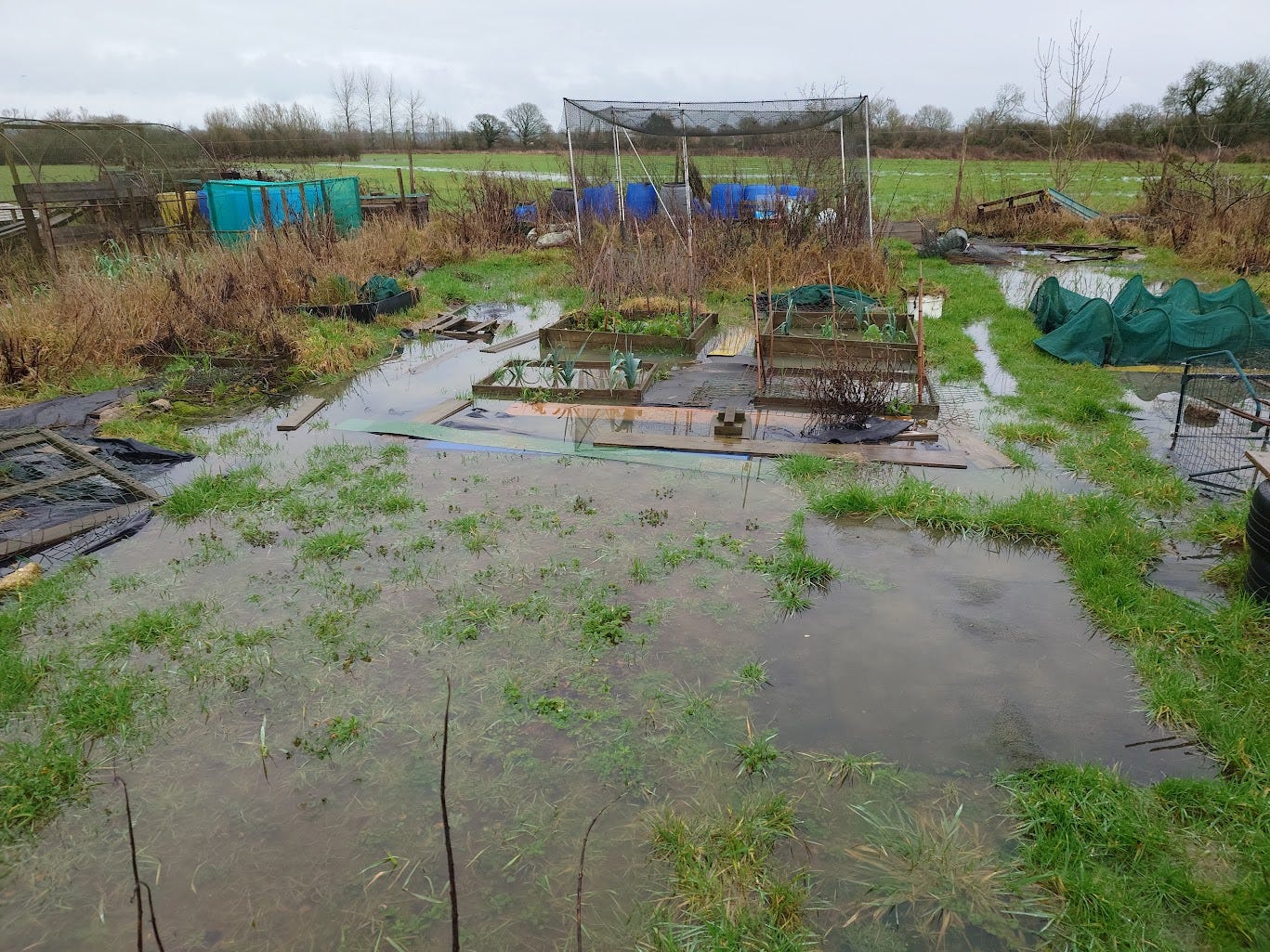
Some of our allotments on the farm had standing water, but it quickly drained away (photo above). However, the soil is still waterlogged and needs to be left alone!
The first thing, and one of the most important points is don’t walk on waterlogged soil or lawns – the weight will cause even more oxygen to be lost and the soil to be compacted which will just add to the waterlogging problems. This damage can take years to undo.
Check your plants and if leaves start to turn yellow and there is some die back, then they are suffering from waterlogging. The yellowing is called chlorosis caused by a loss of chlorophyll and its best to remove these yellowing shoots. If it’s a valuable plant, you may want to consider lifting it and temporarily placing it in a drier spot until conditions return to normal. Another important point – plants that are stressed are more susceptible to disease, especially those caused by fungi. You may also notice that bark starts to peel on shrubs and trees, and growth in spring is slow or stunted and some branches start to die back. Prolonged waterlogging may result in the decay of the root systems of herbaceous plants, so they don’t reappear in spring.
Winters in the UK are likely to get wetter, so it might be prudent to do some future proofing
Soil structure Clay soils are the worst for waterlogging so if you have heavy clay soils, you can improve them by adding lots of organic matter. It could be compost, leaf mould, spent compost from pots. It helps soil structure by opening up the pores and improves drainage. I don’t mix it in as I have no dig beds, so I add the compost on top and let the earthworms do the rest.
Raised or mound beds Looking at the photo of the allotments, the beds that were the worst affected were those where the soil had subsided and were lying below the level of the paths, so water flowed into them. Mounding the soil, creating ridges & furrows, or building raised beds would help to keep plant roots above ground level, and less affected by flooding or standing water.
In areas prone to waterlogging, you can plant trees and shrubs on small mounds so that water runs away from the roots.
Most temperate deciduous trees can cope with waterlogged conditions for several weeks in winter as they are in a state of dormancy. But if the waterlogging occurs when the roots are active, then damage can be more extensive. There are plants that have coping mechanisms and will cope with waterlogging and the lack of oxygen. Willows are a good example. Shrubs such as dogwood and pyracantha cope well too. Hostas love the damp, as do sedges (Carex spp.) Persicaria, and Rodgersia I have listed some ideas below - please add other suggestions in the comments
If you have an area that is waterlogged for long periods in winter you could dig a trench and backfill with gravel to allow water to drain away, build a soakaway, if you have a slight slope, dig a swale to carry the water away or work with the conditions and turn it into a pond or rain garden.
Can I eat crops from a flooded allotment or garden?
Short answer is no. Don’t eat any vegetables that were in the ground at the time of flooding, even those that will be cooked. Guidance suggests that the ground should not used for at least one year and even longer for salad crops, to be sure that sure any contaminants, spores, and disease-causing bacteria are long gone.
If your vegetable plot has been flooded and you have lost your crop, the quickest way to recover is to build some new raised beds and fill them with materials sourced from an unflooded area. The ultimate ‘quick fix’ raised bed is a one tonne bulk bag filled with compost. You can make use of containers and grow bags too. But, don’t be tempted to fill the new beds with compost from any compost bins that have been flooded.
Is your garden prone to flooding?
If it is, think about using plants that can cope with being waterlogged for days or longer.
Here are a few suggestions:
Perennials: Astilbe chinensis, Astrantia major, Cardamine quinquefolia (lady’s smock) Cirsium rivulare (plume thistle), Eupatorium (Joe-pye weed), Filipendula ulmaria (meadow sweet), Geranium sanguineum (crane’s-bill geranium), Hemerocallis (daylily), Hosta, Iris sibirica (Siberian iris) and Iris pseudacorus (yellow flag iris), Ligularia (leopard plant), Lychnis chalcedonica (Maltese cross), Lythrum salicaria (purple loosestrife), Lobelia cardinalis (cardinal flower), Persicaria amplexicaulis (bistort), Primula candelabra (candelabra primula), Trollius europeaus (globe flower), Thalictrum delavayi (meadow rue), Phormium tenax (New Zealand flax), Rodgersia aesculifolia and R. pinnata.
Grasses and sedge: Carex including Carex buchananii, Miscanthus and Pennisetum alopecuroides
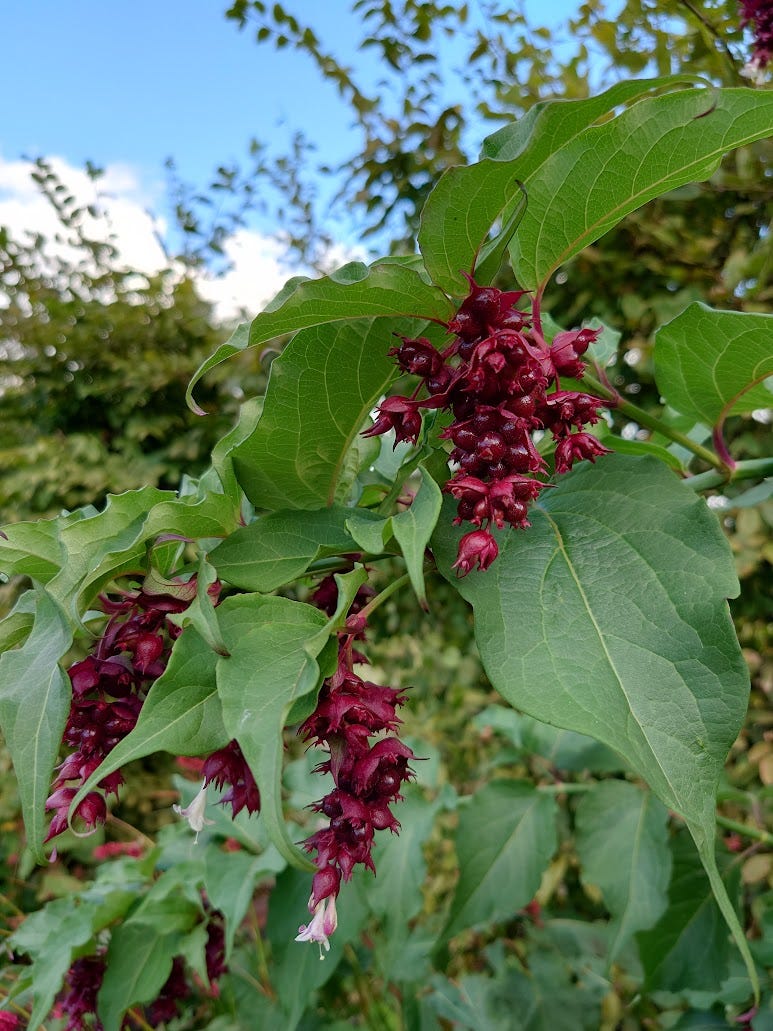
Shrubs: Cornus alba and Cornus sericea (dogwood), Sambucus racemosa (elder), Leycesteria formosa (Himalayan honeysuckle), Pyracantha (firethorn), Spiraea japonica and Viburnum opulus (guelder rose)
Trees: Amelanchier lamarckii, (snowy mespilus), Alnus glutinosa (alder), A. cordata (evergreen Italian alder), Betula nigra (river birch), Carpinus betulus (hornbeam), Populus sp. (poplar), Sorbus aucuparia (rowan), Taxodium distichum (swamp cypress) and Salix (willow)
Happy gardening

PS If you enjoyed reading this post, please click the ‘like’ button at the bottom, it really helps make my posts more visible on the SubStack app. Thank you xxx
Coming up in 2026 - talks and workshops
3 February online talk for Garden Master Class on The importance of microclimates and transition zones in the garden
16 February, Fagus Garden Club at Nailsea nr Bristol
28 March Unlocking the power of organic gardening I am delighted that Becky Searle (IG sow_much_more) is coming to the farm to run a workshop ongrowing organinc veg, soil, composting with a bit of soil microscopy included. There is a £10 discount for paid subscribers. Message me for more info and the discount code. Book here
12 April ‘Creating a climate-resilient kitchen garden ’ led by me at the farm in Somerset. It complements Becky’s course on 28 March. It’s aimed at people who are keen to grow vegetables or have taken on an allotment and want to learn more and to make their growing space more climate change resilient. I include topics such as composting, mulching, Bokashi, polycultures, hugelkultur, unusual veg, perennial veg and more. There is a £10 discount for paid subscribers. Message me for the discount code. Book here
14 April Cricklade Garden club
22 April Stoke Sub Hambdon nr Yeovil
4 May Wyche and Colwall Garden Club, nr Malvern
13 May Marlborough
20 May Blackhills, nr Taunton
26 May East Mendip at Oakhill
27 May North Bradley nr Trowbridge
And later in the year I am opening my garden for the National Garden Scheme on Sat 1 Aug and Sunday 6 September
The south west has really had a time of it, with more rain to come. We're in the Scottish Borders and it seems like it's been raining for weeks. Luckily, we're not in a flood prone area with no streams nearby. But the ground is saturated and we have a sump pond that is now full and water is flowing from the drainage pipe into a gully.
We've started a veg bed this year on the higher ground in the garden so I'm hoping for good results. It will be trial and error.
I was very interested to read your post. I hadn't realised that you couldn't eat the produce from a veg bed after flooding. It makes sense now you've said it but goodness, what a waste! Heartbreaking too I imagine.
Really apprieciate the detailed breakdown on waterlogged soil biology. I had root die-back last spring from ignoring wet patches in raised beds and now I'm mounding everyhting. The list of flood-tolerant perennials is gold especially Ligularia becasue those get overlooked.